


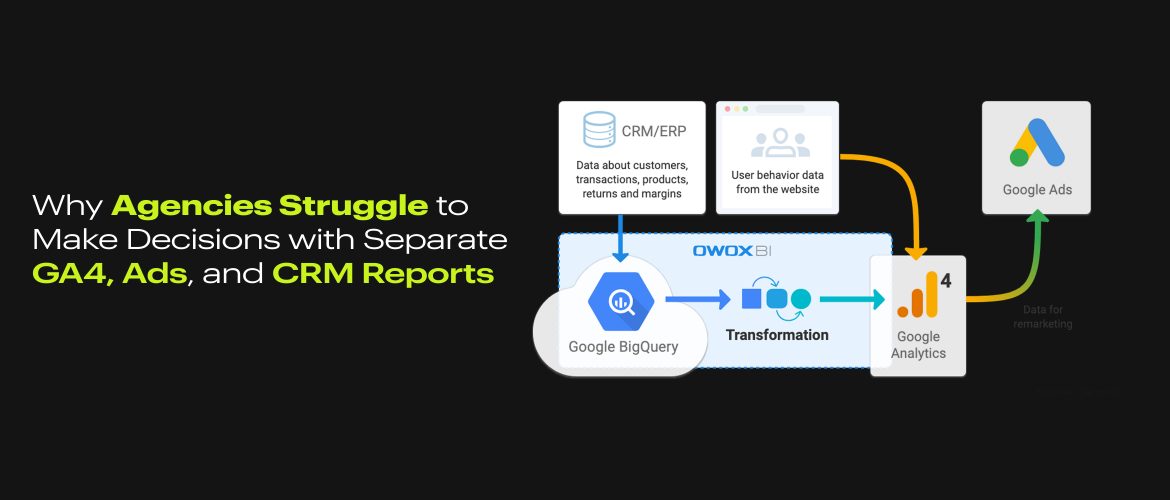
You review GA4 data, ad platform reports, and CRM numbers regularly. Each report looks accurate on its own, yet decision-making still feels slow and uncertain. Metrics do not line up, performance trends feel unclear, and explaining results takes more effort than it should.
The issue is not data availability. The issue is how reporting is separated across platforms.
When GA4, advertising platforms, and CRM systems operate independently, it becomes difficult to understand what is actually driving results. This is a common problem for digital agencies managing multiple clients and channels.
The Core Issue with Separate GA4, Ads, and CRM Reports
Each platform measures a different part of the marketing journey.
GA4 focuses on:
- User behavior and engagement
- Traffic sources and on-site actions
- Event-based interactions
Ad platforms focus on:
- Spend, impressions, and clicks
- Conversion tracking
- Campaign-level performance
CRM systems focus on:
- Lead capture and qualification
- Pipeline activity
- Revenue attribution
When these systems are reviewed separately, you are forced to connect insights manually. Separate GA4 Ads CRM reports often show activity, but not the full performance picture.
Why Disconnected Reporting Creates Decision Delays
Fragmented data increases the time required to analyze performance. Before you can act, you often need to:
- Export reports from multiple tools
- Align date ranges and attribution windows
- Reconcile mismatched metrics
- Explain inconsistencies to stakeholders
This slows internal reviews and delays optimization decisions. These delays are among the most common agency reporting challenges, especially for teams managing paid and organic channels together.
How Reporting Silos Lead to Conflicting Metrics
Different platforms use different definitions and measurement models. This causes discrepancies that reduce confidence in reporting.
Common issues include:
- Conversions reported differently across GA4 and ad platforms
- Leads appearing in CRM without a clear campaign source
- Revenue not aligning with marketing performance data
When metrics conflict, teams hesitate to make changes, and client conversations shift from strategy to data validation.
The Effect on Strategy and Client Conversations
Clients expect clarity and direction. When reporting is siloed, it becomes harder to explain performance in a simple and confident way.
Disconnected reporting often results in:
- Longer performance explanations
- Reduced confidence in recommendations
- Slower approval for budget or strategy changes
Strong cross-platform marketing reporting helps you show how traffic, ads, and leads connect to real business outcomes.
Why Unified Reporting Improves Decision Quality
When GA4, ad data, and CRM insights are viewed together, patterns become easier to identify.
Unified reporting allows you to:
- See how traffic turns into leads and revenue
- Identify which channels support long-term growth
- Reduce manual reporting effort
- Improve accuracy and consistency
This shifts reporting from metric review to performance understanding.
Turning Reporting into Decision Support
For many agencies, aligning GA4, ad platforms, and CRM data requires time, technical setup, and ongoing maintenance. A reporting partner like DAT helps agencies structure cross-platform reporting so performance data is aligned, reliable, and easier to interpret. This allows agency teams to focus on strategy and client decisions instead of reconciling reports.
FAQ
Each platform tracks a different part of the customer journey. GA4 measures user behavior, ad platforms track campaign activity, and CRM systems record leads and revenue. When reviewed separately, the data does not align.
GA4 lacks full context when viewed alone. Without ad and CRM data, it is harder to understand how traffic connects to leads and revenue, which slows decision-making.
Unified reporting connects GA4, ad data, and CRM insights in one view. This helps agencies understand performance clearly and make faster, more confident decisions.
Final Takeaway
Agencies struggle to make decisions when GA4, ads, and CRM reports operate in silos. Disconnected data leads to conflicting metrics, slower analysis, and weaker strategic clarity. By aligning reporting across platforms, you reduce friction, improve understanding, and turn reporting into a reliable foundation for decision-making.